dimanche 19 février 2017

Hands on: Adata SD700 External SSD review


Hands on: Adata SD700 External SSD review


Hard disk drives used to dominate the world of external storage, but the arrival of silicon-based technology has changed the norm and gobbled away their market share within a few years.
While the first flash USB drives lacked the capacity and the speed to match external HDDs, more recent models have managed to surpass them except when it comes to price per unit of storage.
For a growing minority though, adopting silicon-based storage will have proved to be life-changing, especially if they opted for mid-sized SSDs.
With barely any external hard drives available with a capacity lower than 1TB, solid-state drive vendors have had a field day, multiplying the number of SKUs between 64GB (the most popular USB drive capacity) and 1TB (which is where most external HDDs start, as mentioned).
Available in 256GB, 512GB and 1TB versions – in black or bright yellow colour schemes – the Adata SD700 is one of several external SSDs that aspire to compete with hard disk drives while offering many appealing features.
The most obvious one is that it is significantly smaller and lighter than your average portable hard drive – the latter usually sport a 2.5-inch hard disk and weigh more than 200g.
In contrast, the SD700 weighs a mere 74g (the iPhone 5C is 132g in comparison) and is a compact 85 x 85 x 14mm in size, making it a lot more pocket-friendly than even the smallest platter-based HDD.
Then there’s the fact that it’s IP68 rated which means that it should be protected against water ingress to a maximum depth of 1.5 metres for up to 30 minutes, as well as being protected against the ravages of dust.
It’s also tested to military grades (MIL-STD-810G 516.6) to withstand shock even when in use (although the cable might become loose or the connector might break).
In other words, assuming that the USB port cover is firmly closed and secured in place, this is one of the most solid high capacity devices you can buy. A proper ruggedized storage drive if you’re looking for one.
The drive is protected by a non-removable rubber ring and the electronics are enclosed by an aluminium chassis, with the ADATA logo and the word SSD displayed prominently on top, and a blue status light just below.
CrystalDiskInfo recognised the drive as being the SU800 which we reviewed last year. It makes sense for Adata to use the same components to make the most of economies of scale.
That meant teaming the Silicon Motion SMI SM2258 controller with IMFT’s 384Gbit TLC 3D NAND flash modules and what Adata describes as a DRAM cache.
Switching to 3D NAND ensures that the drive consumes even less power per unit storage, packs more bits per unit volume and heats up less (it was barely warm during our tests).
It connects to any host computers using a USB Type-A connector (v3.1 gen 1) meaning that the maximum theoretical transfer limit is 5Gbps, the same as that of v3.0. A Type-C connector might have been preferable since most new high-end laptops come with these.
Adata throws in a three-year warranty, a rather thick but short cable, as well as a few software goodies including Macrium Reflect backup suite, an SSD toolbox, Acronis True Image HD and OS to Go. The SD700 supports AES 256 Encryption and users can use this function through ADATA's “HDDtoGO” which can be downloaded from the website.
In our benchmarks using CrystalDiskMark, the SD700 hit 433MBps and 427MBps in read and write speeds respectively, which is about an order of magnitude faster than magnetic hard disk drives.
Compared to the SU800 though, which reached 563/508MBps in the same benchmark, it is a bit of a disappointment – although an expected one because of the limitations of USB and the overhead associated with having a USB-to-SATA bridge.
Should you want to open the drive, the two parts of the shell come off using a flat screwdriver. Other than the NAND chips, there’s also a single Nanya NT5CC256W DRAM chip, which could either be a 256MB or a 512MB DDR3 buffer.

Early verdict

At just under £153 (around $190, AU$250) at the time of writing, this portable drive is slightly less expensive than the likes of the Samsung T3 or the SanDisk Extreme 500 while offering an extra 12GB and 32GB respectively. The margin is even wider when compared to LaCie’s rugged SSD range.
You still pay a premium compared to the SU800 (about 17%), which is essentially the same drive, and that’s slightly annoying but then the SD700 targets a niche.
Moving forward, Toshiba/Western Digital now have 512GB 64-layer 3D NAND chips in their portfolios with IMFT and Samsung likely to follow suit within a few months.
They represent a 50% improvement on the chip used in the SD700 which means that a 2TB model is likely to appear later this year.
We would love to see a smaller version of the drive – a physically smaller model that is – something that should be possible if the next iteration adopts a USB Type-C connector. The current one is notoriously fragile and far too chunky for a thinner, nimbler drive.


mercredi 15 février 2017

Honor 6X review


Honor 6X review


The Honor 5X from early 2016 was one of the best low-end phones you could buy last year – we even gave it four out of five stars.
Honor wants to replicate that success in 2017 with the Honor 6X, with a few minor improvements and a similarly low price point to encourage you to go with the up-and-coming Chinese brand.
There are a lot of specs here that not so long ago you’d have expected to only feature in upper mid-range to high-end phones, yet Honor has managed to pack them into something substantially cheaper. 
But things progress quickly in the world of phones, and these days there's strong competition at this end of the market from the likes of the Moto G4 and Moto G4 Plus, so can the Honor 6X compete?

Honor 6X price and release date

  • The Honor 6X costs a little more than the Honor 5X did this time last year
  • It's still not expensive at $249.99 (£229, about AU$390)
  • Out now in the US and UK, no sign of Australia
You can buy the Honor 6X now in the UK and US while it's not currently clear if Honor will be bringing the phone to Australia in the foreseeable future.
Pricing-wise Honor has set the 6X price at $249.99 (£229, about AU$390), which is more than the launch price of the Honor 5X, as that cost just $199.99 (£189.99, about AU$275).
In the US, there was a flash sale in January 2017 that brought the price down to $199.99, but there's no sign of Honor running the same promotion again. We've also seen the Honor 6X slightly cheaper at Carphone Warehouse in the UK at £224.99.
Given that the Honor 5X is now even cheaper than it was at launch it’s a shame Honor has decided to raise the price of its new handset, but the flash sale pricing is impressively low.

Key features

  • Limited key features compared to flagship phones like Honor 8
  • Useful fingerprint scanner on the back of the phone
  • Honor's signature dual-lens camera, but not as we've seen it before
The Honor 6X isn’t packed full of the latest smartphone features, but it has a few key highlights that mean it stands out against a lot of the competition.
One of these is the fingerprint scanner on the back of the phone. Phones at this price point still don’t all have the added security of a fingerprint scanner, but this one does and it's one of the speediest around.
Being on the back means it’s in a useful position for when you have the phone in your hand, but it can get irritating if you put your phone down a lot on desks.
Another key highlight is the camera – there's a dual-sensor shooter on the back of the Honor 6X and this is one of the first times we have seen this kind of setup on a budget phone.
It means you can use the wide-aperture mode to focus your shots on objects in the foreground and blur the background of each photo. It’s a great little trick and one you won’t be able to get on any other modern smartphone that costs as little as the Honor 6X.

Design and display

  • Metal unibody design, but may be too big for some people
  • Full HD 5.5-inch display offers a bright and clear picture
Unlike most of the phones at this price point, Honor has managed to include a metal unibody design here that gives the 6X a slightly premium feel.
The build quality isn’t fantastic and it doesn’t sit as comfortably in the hand as the Honor 8 or Huawei Mate 9, but it does still feel more premium than, say, the plastic-backed Moto G4 Plus.
Those with small hands may find the Honor 6X a little difficult to hold with its 5.5-inch screen in the middle, but we enjoyed using it.
It’s a touch thicker than we’d hoped for at 8.2mm, but it’s not unweidly at that thickness.
The power button on the right hand side of the phone is easy to reach with your thumb, while the volume rocker sits just above it and again is easy to tap. 
There’s a fingerprint sensor on the back of the phone and the dual camera sits just above that, jutting out more than we'd like.
It means the phone doesn’t sit flat when placed on a surface, but it’s a better choice than making the entire handset thicker.
The corners of the phone are rounded off well and don’t feel uncomfortable when you hold it. It’s also worth noting the 3.5mm headphone jack at the top right of the handset.
This is in a good position for when you’re listening to music on the go and want to keep your phone upright in your pocket.
Color-wise you’ve got three options on the Honor 6X. There’s a silver, a gold and a gray version. The differences between gray and silver are minimal though and the gold version isn’t particularly eye-catching.
That's not necessarily a bad thing though. For the purposes of this review we had the gold version of the 6X, and it never felt embarrassingly flashy like some gold or rose gold colors can on phones.
As for the Honor 6X's screen, for what it costs you'll likely be happy with the setup.
It's a large screen at 5.5 inches, offering up a 1080p resolution. You could get a slightly clearer image by opting for a phone with a QHD display, but that's not going to happen at this price point.
The Honor 6X has a nicely bright screen with good viewing angles. Colors look OK and the brightness can go up to a great level.
Auto-brightness on the Honor 6X works well too and we found it best to just leave that on and let it do its thing.
The bezels around the screen on the Honor 6X are quite thick, but this doesn't make it any more difficult to use the phone and only impacts upon the look of the handset rather than how it works.

Hands on: Panasonic EZ1002 OLED review


Hands on: Panasonic EZ1002 OLED review


It’s rare that we find ourselves getting too excited by a television’s sound set-up, but we did exactly that when we first laid eyes on Panasonic’s new OLED television, the Panasonic EZ1002, which was announced at CES 2017. 
TODO alt text
The new set is Panasonic’s flagship television for 2017, and is expected to be available by around June 2017, at a price that’s yet to be announced. The set will have the model number EZ1000 in mainland Europe, and EZ1002 in the UK, the latter indicating the model’s support for Freeview Play. 
We got a chance to try the television out for ourselves on the show floor, and we came away impressed not only by the television’s image performance, but also by its audio set-up, which we felt offers a nice compromise between sound quality and thinness. 

Design

OLED’s have always faced a bit of a dilemma when it comes to sound. The television panels themselves can be made as thin as just a couple of millimeters, but it’s rare that you’ll actually see a television make full use of this fact. 
One of the reasons for this is that this amount of thinness is absolutely terrible for speakers, which need a decent amount of space to actually produce sound that isn’t weak and tinny. 
Both the Panasonic EZ1002 and the recently announced LG OLED W7 Signature Series have come up with novel solutions to this problem, although to our mind the EZ1002’s is the slightly more versatile of the two. 
Both sets achieve a thinner profile by separating their speakers from the panel itself, but the specifics of this process differs slightly between the two. 
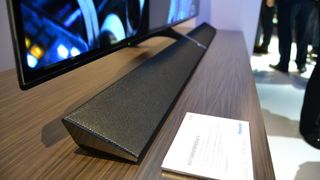
In the EZ1002’s case, the core electronics of the television remain in the body itself, while the W7 puts it all into the soundbar. This means that the EZ1002’s panel itself is slightly thicker to accommodate the circuitry, but because only the sound has been outsourced to the bar, you’re free to swap out the included soundbar with one of your own choosing, which isn’t possible with the W7. 
It might not reach the same wallpaper thinness of the W7, but this design decision means the Panasonic EZ1002’s audio should be much more versatile.
The one caveat is that you'll have to wall-mount the EZ1002 if you want to detach its soundbar, as the speaker is an integral part of its stand. Detach the soundbar and the TV won't sit comfortably on your cabinet at all. 
In fact, if you do end up wall-mounting the EZ1002 you might want to detach the soundbar anyway, as we saw it forced to stick out at a rather ugly angle when it was wall-mounted at the event. 
  • If you’re in the market, check out our guide to the best soundbars around today.

Performance

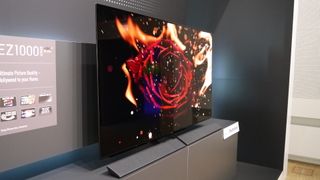
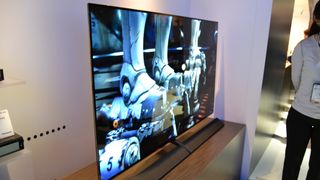
The EZ1002’s image quality hits the high’s that we’ve come to expect from OLED panels. Black levels are delightfully deep and rich, and colors are bright and vibrant. 
Somewhat confusingly, Panasonic is claiming that the television is “the world’s first HDR-capable, Ultra HD OLED TV” which seems odd given that LG’s OLED panels have supported the technology previously. 
It seems that this claim is born out of the EZ1002’s support for the new HDR standard, Hybrid Log Gamma, which broadcasters such as the BBC will be using for live HDR broadcasts. 
However, Panasonic has quickly been joined by LG in offering OLED HLG support, so it was a lead that was short lived. 
Regardless of the HDR confusion, we came away impressed by the HDR capabilities of the EZ1002, which Panasonic claims is able to offer almost double the peak brightness of conventional OLEDs. 
We saw it running next to Panasonic's previous OLED model, and the extra brightness was especially beneficial to the colors, which really popped. 
Color reproduction is excellent, and Panasonic claims this has been enabled by its own Hollywood Lab. We’re always a little sceptical of these claims, but the colors on display with the EZ1002 looked suitably impressive. 
Panasonic also demoed the set next to a recent LG OLED model, although they unfortunately were not disclosing which LG set it was exactly. 
This was done to show off the noise-reduction and color-banding removing capabilities of the set, but it also unfortunately showed off a lack of sparkle in the brightest parts of the image, which looked a little flat in comparison to the LG model. 
The sound quality of the EZ1002 is really excellent. Panasonic is advertising that the set is 'Tuned by Technics' (the company's audio brand), but all we know is that we heard the set running next to an LG OLED from last year and it had a fantastically open and balanced sound in comparison. 
This sheer amount of drivers in the EZ1002 probably have something to do with that. There are two tweeters, two squarkers, and four woofers, which work to create a fantastic sound that's was deep and open. 
You can of course remove this soundbar to replace it, but with it sounding this good only people who are chasing surround sound setups will probably bother. 
All of the EZ1002’s content is accessed through Panasonic’s  'My Home Screen 2.0' operating system, which looks like it might be one of the more intuitive TV OS’s out there. 

Early Verdict

The Panasonic EZ1002 is a great looking OLED that appears to have found a convenient way around the panel technology’s awkward compromise between screen thinness and sound quality. 
The screen itself is sleek and thin, picture quality is excellent, and in particular the set’s deployment of HDR is sure to turn heads. 
The big question is how much this set will end up costing. As Panasonic’s 2017 flagship it’s unlikely to be cheap, but we’re crossing our fingers that it doesn’t leave our collective wallets in too much pain. 

New Nokias release date, news and rumors.

New Nokias release date, news and rumors.


Nokia – or at least HMD, the company with the rights to the Nokia brand – has recently announced a new phone, dubbed the Nokia 6.
But that could just be the tip of the iceberg, as it’s rumored that three or four other Nokia phones are in the works, and that some or all of them may be shown off at Mobile World Congress (MWC 2017) at the end of the month.
These include the high-end Nokia 8, the Nokia 5, Nokia 3 and Nokia 3310. Here’s everything we’ve heard about them so far.

Cut to the chase

  • What are they? The next range of Nokia-branded phones
  • When are they out? Launching February 26
  • What will they cost? Likely to start very cheap and rise high

New Nokias release date

Hottest leaks:
  • Launch date: February 26
Technically the Nokia 6 is already out, but only in China for now. There’s no news on if or when it will be released more widely, but HMD might well spill the beans at MWC 2017, as it’s holding a press conference there on February 26.
The save the date card says simply that HMD will reveal “the next exciting chapter in the Nokia consumer story”, so it’s sure to talk up some phones, but we don’t yet know which.
However, according to one source the Nokia 6, Nokia 5, Nokia 3 and Nokia 3310 will all be shown off, suggesting that they could all get a widespread release, though early pricing rumors are in Euros, suggesting they may still not make it to the US or Australia.

New Nokias screen

Hottest leaks:
  • 5.2-/5.3-inch 720p display for Nokia 3
  • 5.2-inch 720p display for Nokia 5
  • 5.5-inch QHD display for Nokia 8
We already know that the Nokia 6 has a 5.5-inch 1080 x 1920 screen, but so far we can only go by rumors for the rest of the range.
Slotting in below, the Nokia 5 is said to have a 5.2-inch 720 x 1280 screen, while above both of those we’re hearing rumblings of a Nokia 8 with a 5.5-inch or 5.3-inch 1440 x 2560 QHD screen.
The Nokia 3 has been tipped to pack either a 5.2- or 5.3-inch 720p display, while the new Nokia 3310 will be down at the bottom in terms of size and resolution.

New Nokias design

Hottest leaks:
  • Metal shells and water resistance at the top end
  • Plastic for lower end models
The mid-range Nokia 6 has a metal body, so it’s likely that the Nokia 8 will as well, and indeed that’s been rumored.
It’s also rumored to be dust and water resistant. Little else is known about the Nokia 8 yet, but the picture below, shared by MyDrivers, supposedly shows it. If accurate, we can look forward to a fairly plain metal unibody with antenna lines at the top and bottom of the back.
Credit: MyDrivers / KKJ.CN
We don’t yet know anything about the design of the Nokia 5 or Nokia 3, but there’s a good chance that they’ll swap metal for plastic, given their low-end position. 
The new Nokia 3310 meanwhile is all but guaranteed to be plastic, and may have swappable fascias, since its ancient namesake does.

New Nokias camera and battery

Hottest leaks:
  • A 23MP camera for the Nokia 8
  • Nokia 5: 13MP and 8MP
  • Nokia 3: 13MP and 5MP
The Nokia 6 has a 16MP rear camera with a dual-LED flash, while round the front there’s an 8MP snapper. 
The Nokia 5 meanwhile is rumored to have a 12MP or 13MP rear sensor, but may stick with an 8MP one on the front (though elsewhere we’ve heard that it may have a 13MP and 5MP pairing), while Nokia 8 leaks talk about a 23MP rear camera.
On the entry-level Nokia 3 a spec leak suggests you'll find a 13MP camera on the rear, and a 5MP offering on the front.
There’s little known about the new Nokia 3310, but there's a good chance it won't feature any cameras.
So far there aren’t any battery rumors yet, but we know that the Nokia 6 has a 3000mAh one, so it’s likely that the Nokia 8’s will be larger, while the Nokia 5, Nokia 3 and Nokia 3310 may have progressively smaller batteries.

New Nokias OS and power

Hottest leaks:
  • From Snapdragon 425 to Snapdragon 835
  • From 2GB to 6GB of RAM
The Nokia 6 has an octa-core Snapdragon 430 chipset and 4GB of RAM, which is a slightly odd pairing of low to mid-range chip and large amounts of RAM.
The Nokia 5 meanwhile is rumored to have the same chipset but just 2GB of RAM, which seems a more sensible combination, though is ever so slightly different to another leak, which suggests a Snapdragon 425 chipset, 2GB of RAM and 16GB of storage.
That latter spec line up looks like it's destined for the Nokia 3 though, with a different leak showing up the same details.
Early Nokia 8 rumors suggest a Snapdragon 835 chipset and 6GB of RAM, which would be flagship specs, though if they’re accurate we may not see it in stores for a few months, as Samsung is rumored to have snapped up the first batch of 835’s.
There aren’t any known specs for the Nokia 3 or Nokia 3310 yet, but we wouldn’t expect much from them – the Nokia 3 will be an entry-level smartphone, while the 3310 is likely to be more of a feature phone.
For that reason it’s also unlikely that the Nokia 3310 will run Android, but the others likely will, and more specifically they’ll probably run Android Nougat, as the Nokia 6 already does.

New Nokias other features

Hottest leaks:
  • An AI assistant
  • A fingerprint scanner
The Nokia 6 has a fingerprint scanner, so the Nokia 8 (if it exists) probably will as well, though it may not trickle down to the Nokia 5 or below.
So far we don’t know what else to expect, other than possibly an AI-assistant called Viki, but the Nokia 8 is the only one that’s likely to have much in the way of extra features, as the others are likely to be low cost handsets.

New Nokias price

Hottest leaks:
  • Prices from $60/£50/AU$80 to $265/£210/AU$345
Head over to China and you can pick up the Nokia 6 for ¥1699 (about $245, £200, AU$335), but it’s rumored that it will arrive in Europe with a price tag of €249 (about $265, £210, AU$345).
The Nokia 5 meanwhile is said to be coming for €199 (about $210, £170, AU$275), and the Nokia 3 for just €149 (about $160, £130, AU$205).
At the very bottom end there’s the Nokia 3310, which is rumored to cost just €59 (about $60, £50, AU$80), but again, this is likely to be more feature phone than smartphone.
There aren’t any pricing rumors for the Nokia 8 yet, but assuming it exists it’s sure to be the most expensive of the bunch, with a likely price upwards of $700/£560/AU$910.